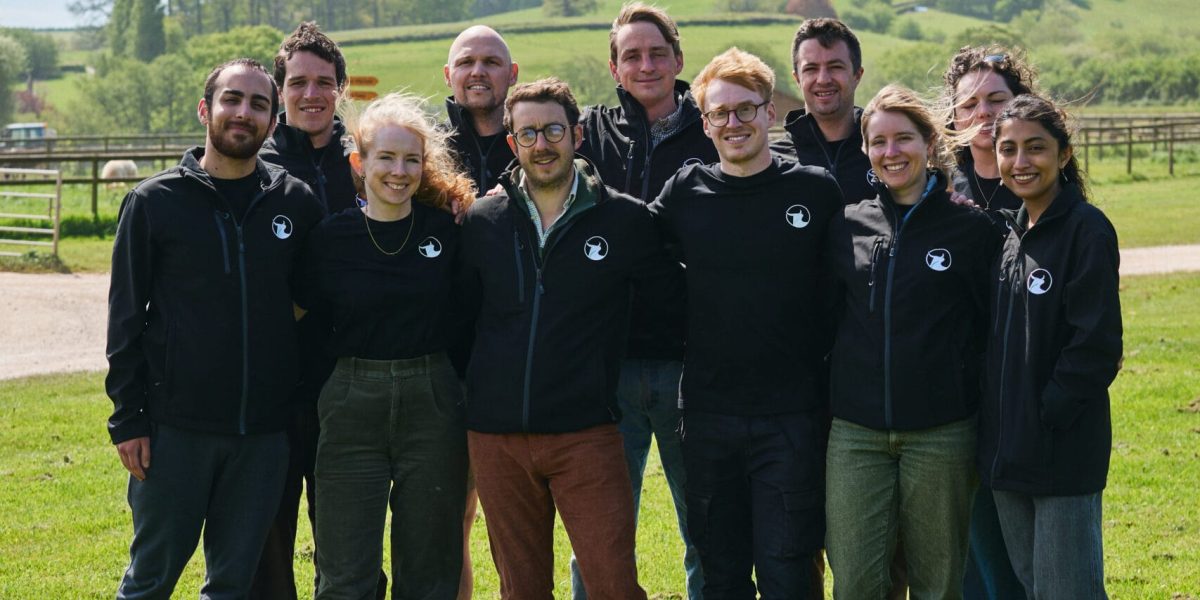
When Black Bull Biochar relocated from London to Manchester, the team weren’t just seeking a change of location. For CEO & Co-founder Alex Clarke, it was a strategic decision to realign the business with how it actually operated.
Formerly headquartered in London, the start-up produces biochar, a carbon-rich material created from biomass that locks carbon away and improves soil health. It works across agriculture, energy and carbon markets, with operational sites in Greater Manchester and Penrith and customers ranging from local farmers to large corporates.
But as the business grew, Clarke could see that keeping its centre in London was becoming increasingly disconnected from operational reality.
The team was spread across Manchester, London and Edinburgh, but the work itself was increasingly tied to sites in the North West. Even the opportunities the business was pursuing were no longer centred in the capital.
“London has a clear pull when it comes to launching a company, but growing a team in the capital doesn’t make sense when you’re so far away from the operational side of things,” Clarke says.
From Clarke’s perspective, staying in London would have meant continuing to build the business at a distance from its operations, while hiring in an expensive market that didn’t reflect where the company was actually working or where the opportunities were emerging.
Clarke’s choice to relocate himself and the HQ of the business to Manchester was a deliberate call. It brought the business closer to its operational footprint and into a city where there is a genuine buzz and excitement around business growth. But for the team, the move only solved part of the problem.
The second decision
Relocation addressed where the business would be based, but it didn’t solve how the team would work in practice once it got there.
At the point Black Bull Biochar was building out its Manchester presence, Clarke was also hiring, so the environment that new team members were walking into mattered more than ever.
“A lot of offices can feel corporate and uninspiring, and with us bringing in this new team, we wanted people to feel energised. We knew that if people didn’t want to be there, the workplace becomes part of the problem.”
For Clarke, that meant the search in Manchester wasn’t just about finding space, but finding an environment that would actively support how the talent needed to grow.
Choosing the right workspace
Clarke had already seen Department at Bonded Warehouse before the business formally began its search. “Bonded Warehouse caught our eye immediately. From the refurbished industrial feel to the in-house gym and surrounding area of bars and restaurants, I knew this is where we wanted to be,’” he says.
So, when the time came to look seriously, that instinct held up.
“The energy at Department at Bonded Warehouse stood out to me as it’s always busy; you really feel like you’re part of something,” he says.
For the team, that energy mattered. Having the presence of other teams and the buzz of sharing a space with larger businesses has helped us build a sense of company culture and motivates our team to come into the office every day. Rather than a quiet, self-contained office, the building operates as a genuinely active workplace – one where proximity to other teams leads to conversations, connections and a shared sense of momentum.
That activity is shaped by how the building is used day to day – from informal conversations over coffee to teams crossing paths in shared spaces, and a regular programme of events that gives people a reason to stay beyond the working day.
There are practical elements too – an independent café, spaces designed for both focus and interaction – but for Clarke and the team, it’s about having access to a place that feels active, social and worth showing up for.
That environment also aligned with how Clarke wanted the business to grow.
Rather than committing early to a fixed private office, he chose to take four desks, with the ability to scale into more space within the building as the team expanded. “We were initially looking for a small four-person office,” he says. “Instead, we’ve taken four desks, which allows us to scale and grow nearby.”
That decision avoided a mistake he had already seen in London. Private offices had felt expensive and restrictive, forcing decisions too early and limiting how the business could adapt.
“Private offices in London are expensive and restrictive,” he says. “We get a lot of flexibility and room for growth here, which is what every startup needs.
The business impact
Since moving to Manchester and into Department at Bonded Warehouse, Clarke has seen a clear shift in the experience of being in the office.
“Being in Department at Bonded Warehouse does make you feel inspired,” he says. “It’s not just me; we’ve even said to each other, we feel so much happier being here.”
But the difference is not just how the space feels; it’s how it’s used. The environment makes it easier to bring people together, integrate new hires and create a shared rhythm of working in one place – something that is increasingly difficult to achieve by default.
Thanks to the team at Department, Clarke can keep his focus on building the business, rather than managing the space around them.
Getting both decisions right
For Clarke, leaving London was a strategic decision to bring the business closer to its operations and opportunities. But it’s the combination of that move – and where the team chose to base themselves within Manchester – that has made the difference.
At Department at Bonded Warehouse, Black Bull Biochar has found an environment that supports how the business is actually growing, giving the team the energy, flexibility and day-to-day momentum needed to build.
And that decision is already supporting results. Following the move, Black Bull Biochar raised more than £4 million in funding, including investment from the Greater Manchester Combined Authority.
“Overall, we’re just happier being here,” Clarke says. “It’s a much better environment for us to grow the team and build the business to where we want to be.”
For other startups considering a similar move, one thing has become clear to Clarke: the idea that you need to be in London to access investment, talent and opportunity doesn’t hold in the same way anymore.
“Manchester has all of that,” he says. “And it’s a lot more connected than people realise.”
Relocating is one decision, but choosing a workplace people actually want to be in is another. In a hybrid world, attendance can’t be enforced – it has to be earned.